

Artwork Details
6-5/8 x 8-5/8 in. (image) 11-1/2 x 18 in. (sheet)
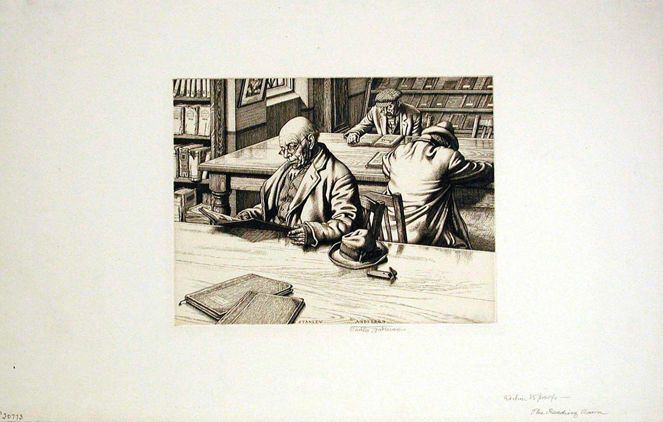
Mark DescriptionSigned in pencil below image, lower center: Stanley Anderson Inscribed in pencil below image, lower right: Edition 85 proofs | The Reading Room
Accession NumberCarl H. Lieber Memorial Fund
CopyrightPrints, Drawings, and Photographs
Color Palette(George J. Saunders); Purchased by the John Herron Art Institute, now the Indianapolis Museum of Art at Newfields, Indianapolis, Indiana, in 1932.
Line engraving had risen to the heights of technical excellence in England in the first half of the 19th century, but, being used largely to reproduce paintings, it was avoided by creative artists. When photography replaced engraving for reproductions later in the century, engraving and all forms of hand printing enjoyed revivals among artists.
Anderson frequently found his subjects amongst England's old, down-trodden and destitute. He would envision them in "conversation pieces," in which two or more persons were shown in a state of dramatic or psychological relation to each other.
Anderson, having apprenticed to a silver engraver, turned to artistic engraving in 1929. This unforgiving medium required forethought before he began engraving into the copper printing plate.
"Though an Anderson engraving is planned largely and seems so easily set upon the plate, there is nothing casual or perfunctory in its making. Its appearance of ease rests not only on its composition, but on a series of conscientious studies of all separate details and incidents. By those means he can make hands or a back speak eloquently as in The Reading Room."
— Martin Hardie
Line engraving had risen to the heights of technical excellence in England in the first half of the 19th century, but, being used largely to reproduce paintings, it was avoided by creative artists. When photography replaced engraving for reproductions later in the century, engraving and all forms of hand printing enjoyed revivals among artists.
Anderson frequently found his subjects amongst England's old, down-trodden and destitute. He would envision them in "conversation pieces," in which two or more persons were shown in a state of dramatic or psychological relation to each other.
Exhibition Name
Venue
Dates
British Qualities: Works on Paper, 1875-1930
Indianapolis Museum of Art
February 16, 2008 - July 13, 2008
Content Disclaimer and Usage Rights
Metadata about the Indianapolis Museum of Art’s collection comes from Newfields’ records and research. In some cases, information may be incomplete and research is ongoing. Newfields’ goal is to have as up-to-date metadata as possible, therefore, this information is subject to change. Newfields collections’ metadata is available under a Creative Commons Zero (CC0) waiver, which allows for re-use without legal restrictions.
Artworks that appear in the image file(s) above may be in copyright or have other legal and/or cultural restrictions to their use. For clarity, Newfields does not claim copyright to the image files created by Newfields of artworks in the Indianapolis Museum of Art’s collection. Newfields makes every effort to ascertain the copyright status of artworks in the Indianapolis Museum of Art’s collection. Please refer to the RightsStatements.org statement above for information about the current copyright status of the artwork. Additionally, some artworks may include Local Context’s Notices or Labels, which are tools that support Indigenous communities to reassert cultural authority in heritage collections and data.
Additional information about Newfields’ reproduction guidelines can be found in the Licensing Resources.